 admin
adminBuilding passive income is no longer just for wealthy investors or retirees. With inflation rising, job markets shifting, and side hustles becoming mainstream, more people are searching for smart ways to make their money work for them. If you have $10,000 saved from a bonus, side business, inheritance, tax refund, or years of disciplined saving, you already have enough capital to begin creating sustainable passive income streams.
The biggest mistake many beginners make is letting cash sit in a low-interest bank account while inflation quietly reduces its value. The smartest investors understand one principle: money should generate more money.
The good news is that you do not need to be a Wall Street expert to start investing. Modern investment platforms, low-cost ETFs, high-yield savings accounts, dividend stocks, REITs, and bond funds have made passive income investing more accessible than ever.
This guide explains exactly how to invest $10,000 for passive income, including:
- The best passive income investments for beginners
- How to assess your personal risk tolerance
- ETF portfolio strategies
- Real estate investing without buying property
- Dividend investing for recurring cash flow
- Bond and fixed-income strategies
- High-yield savings accounts
- A sample $10,000 portfolio allocation
- Risk vs. return comparisons
- Compound interest growth examples
- Beginner-friendly ways to start with as little as $500
Whether your goal is monthly income, long-term wealth building, or financial freedom, this article will help you create a realistic strategy that matches your lifestyle and financial goals.
Why Passive Income Investing Matters
Passive income is money earned with minimal ongoing effort. Unlike active income from a job, passive income allows your investments to continue generating returns whether you are working, traveling, sleeping, or spending time with family.
The most successful passive income investors focus on three things:
- Preserving capital
- Growing wealth consistently
- Generating recurring income
When you invest wisely, your money can produce:
- Dividend payments
- Interest income
- Capital appreciation
- Rental income exposure
- Portfolio growth through compound interest
For example, a well-diversified ETF portfolio for beginners can historically generate average annual returns of 7%–10% over long periods. A $10,000 investment earning 8% annually could grow into more than $46,000 over 20 years without additional contributions.
That is the power of compounding.
Risk Tolerance Quiz: What Type of Investor Are You?
Before choosing investments, you need to understand your risk tolerance.
Answer the following questions:
1. How would you react if your investment dropped 20% during a market downturn?
- A. Sell immediately
- B. Wait cautiously
- C. Buy more while prices are lower
2. What is your investment timeline?
- A. Less than 3 years
- B. 3–10 years
- C. More than 10 years
3. Which statement best describes your goal?
- A. Protect my money
- B. Balance growth and stability
- C. Maximize long-term growth
4. How familiar are you with investing?
- A. Beginner
- B. Moderate knowledge
- C. Experienced
5. Which investment sounds most appealing?
- A. High-yield savings account
- B. Dividend ETF
- C. Growth stock ETF
Your Results
- Mostly A’s → Conservative Investor
- Mostly B’s → Moderate Investor
- Mostly C’s → Aggressive Investor
Understanding your investor profile helps you avoid panic during market volatility and build a portfolio that fits your comfort level.
The Best Passive Income Investments for $10,000
Here are the top investment vehicles for building passive income while remaining diversified.
1. ETFs: The Best ETF Portfolio for Beginners
Exchange-Traded Funds (ETFs) are one of the easiest and safest ways to invest $10,000 for passive income.
An ETF bundles multiple investments together into one fund. Instead of buying individual stocks, you can instantly own hundreds or thousands of companies through one purchase.
Why ETFs Are Great for Beginners
- Instant diversification
- Lower risk than individual stocks
- Low management fees
- Easy to buy and sell
- Excellent long-term growth potential
Some ETFs focus on dividends, while others focus on growth, technology, healthcare, energy, or international markets.
Popular Passive Income ETFs
| ETF | Focus | Average Yield | Risk Level |
|---|---|---|---|
| Vanguard High Dividend Yield ETF (VYM) | Dividend stocks | Moderate | Medium |
| Schwab U.S. Dividend Equity ETF (SCHD) | Dividend growth | Moderate | Medium |
| Vanguard S&P 500 ETF (VOO) | Broad market growth | Lower yield | Medium |
| iShares Core U.S. Aggregate Bond ETF (AGG) | Bonds | Stable | Low |
| Realty Income REIT ETF | Real estate income | Higher yield | Medium |
ETF Allocation Example
A balanced ETF portfolio for beginners might look like this:
- 40% S&P 500 ETF
- 30% Dividend ETF
- 20% Bond ETF
- 10% International ETF
This strategy balances income, stability, and long-term growth.
2. Dividend Stocks for Monthly Cash Flow
Dividend stocks are companies that regularly pay shareholders a portion of profits.
These are often mature businesses with strong cash flow and long histories of stability.
Examples include companies in:
- Banking
- Insurance
- Healthcare
- Telecommunications
- Consumer goods
- Utilities
Many investors love dividend stocks because they can create recurring passive income while still offering long-term growth.
Benefits of Dividend Investing
- Quarterly cash payments
- Long-term appreciation potential
- Inflation protection
- Reinvestment opportunities
Strong Dividend Sectors
Financial Services
Banks and financial institutions often pay competitive dividends because of consistent cash flow and lending profits.
Insurance Companies
Insurance stocks are popular among income investors because of stable revenue streams and long-term resilience.
Healthcare Corporations
Healthcare and pharmaceutical companies often provide reliable dividends due to consistent consumer demand.
3. REITs: Real Estate Income Without Owning Property
Real Estate Investment Trusts (REITs) allow you to invest in real estate without becoming a landlord.
REITs own income-generating properties such as:
- Apartment complexes
- Office buildings
- Shopping centers
- Hospitals
- Data centers
- Warehouses
REITs are legally required to distribute most taxable income to shareholders, making them popular for passive income investors.
Advantages of REITs
- Real estate exposure
- High dividend yields
- Liquidity compared to physical property
- Professional management
Types of REITs
| REIT Type | Properties Owned | Income Potential | Risk |
|---|---|---|---|
| Residential REITs | Apartments | Moderate | Medium |
| Commercial REITs | Office buildings | Moderate | Medium-High |
| Healthcare REITs | Medical facilities | Stable | Medium |
| Industrial REITs | Warehouses | Strong growth | Medium |
| Data Center REITs | Cloud infrastructure | High growth | Medium-High |
Data center REITs have become increasingly attractive due to growth in artificial intelligence, cloud computing, and cybersecurity infrastructure.
4. Bonds and Fixed-Income Investments
Bonds are generally considered safer than stocks and can help stabilize your portfolio.
When you buy bonds, you are lending money to governments or corporations in exchange for interest payments.
Bond Investment Options
- Treasury bonds
- Municipal bonds
- Corporate bonds
- Bond ETFs
Why Bonds Matter
Bonds can:
- Reduce volatility
- Generate predictable income
- Protect capital during downturns
Conservative investors often allocate a larger portion of their portfolio to fixed-income assets.
5. High-Yield Savings Accounts (HYSA)
A high-yield savings account is one of the safest passive income investments available.
Unlike traditional savings accounts, HYSAs offer significantly higher interest rates while maintaining liquidity and FDIC insurance protection.
HYSA Benefits
- Low risk
- Easy access to funds
- Ideal emergency fund storage
- Competitive interest rates
This option works best for conservative investors or money needed within the next few years.
Comparing the Best Passive Income Investments
| Investment Type | Passive Income Potential | Risk Level | Liquidity | Best For |
|---|---|---|---|---|
| ETFs | Medium-High | Medium | High | Beginners |
| Dividend Stocks | High | Medium-High | High | Income investors |
| REITs | High | Medium | High | Real estate exposure |
| Bonds | Moderate | Low | Medium | Stability |
| HYSA | Low-Moderate | Very Low | Very High | Safety |
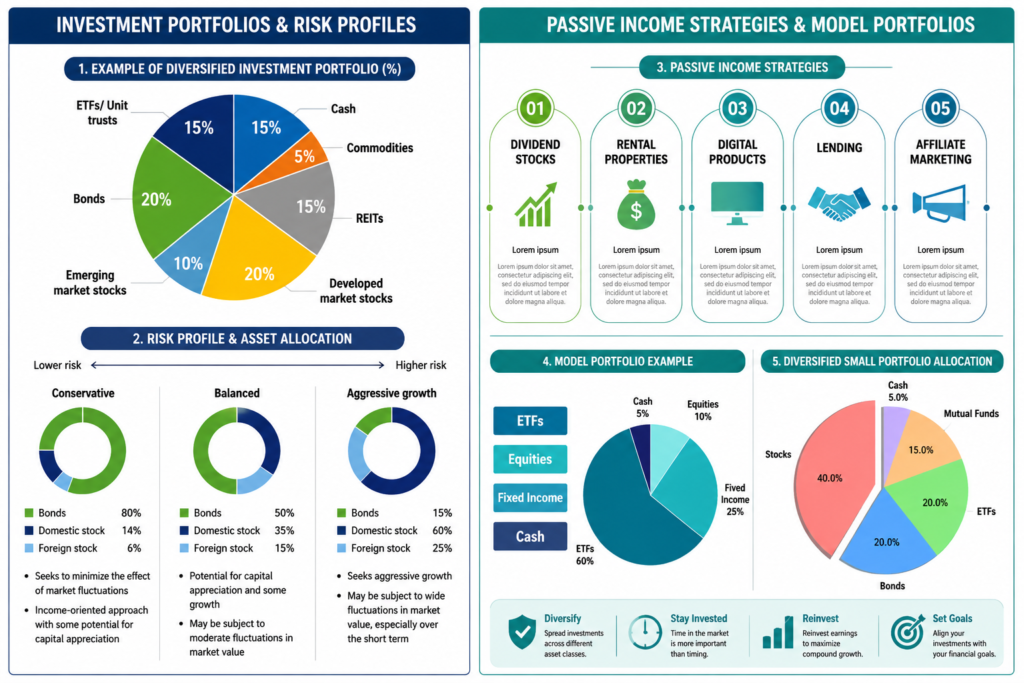
Sample $10,000 Passive Income Portfolio
Here is a beginner-friendly portfolio allocation strategy.
| Investment | Allocation | Dollar Amount |
|---|---|---|
| S&P 500 ETF | 35% | $3,500 |
| Dividend ETF | 25% | $2,500 |
| REIT ETF | 15% | $1,500 |
| Bond ETF | 15% | $1,500 |
| High-Yield Savings Account | 10% | $1,000 |
This portfolio provides:
- Growth potential
- Dividend income
- Real estate exposure
- Stability during downturns
- Emergency liquidity
Portfolio Allocation Pie Chart
Risk vs. Return Explained
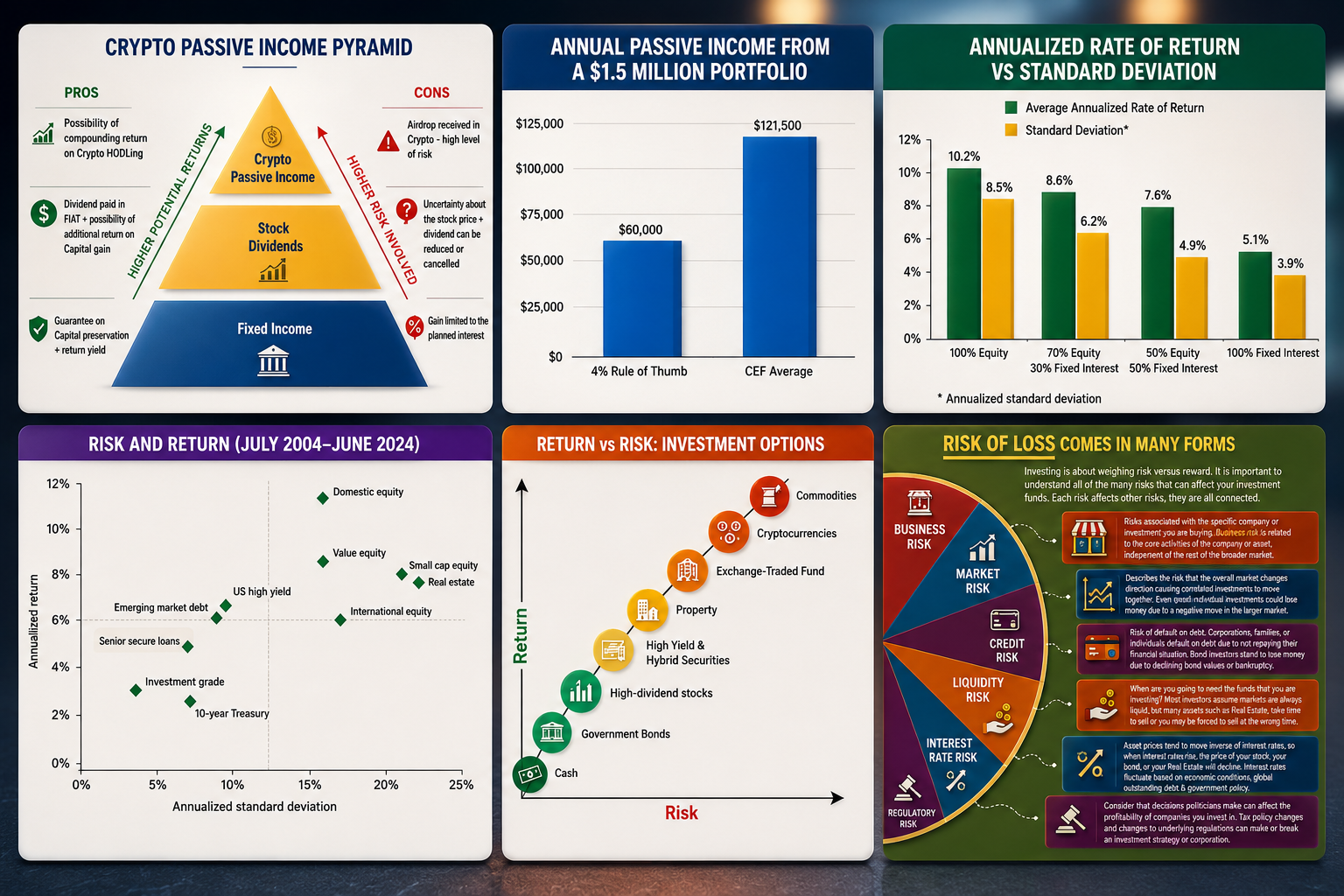
Every investment involves a tradeoff between risk and return.
Generally:
- Lower-risk investments provide lower returns
- Higher-risk investments offer higher growth potential
Low-Risk Investments
- High-yield savings accounts
- Treasury bonds
- Bond funds
Medium-Risk Investments
- ETFs
- Dividend stocks
- REITs
Higher-Risk Investments
- Individual growth stocks
- Cryptocurrency
- Leveraged investments
A diversified portfolio spreads risk across multiple asset classes instead of relying on one investment.
Risk vs. Return Chart
The Power of Compound Interest
Compound interest allows your earnings to generate additional earnings over time.
Instead of withdrawing dividends and interest, many investors reinvest them to accelerate growth.
For example:
- Initial investment: $10,000
- Annual return: 8%
- Time period: 20 years
Using compound growth, your investment could grow to approximately:
- 10 years → ~$21,589
- 20 years → ~$46,610
- 30 years → ~$100,627
That growth happens without adding additional money.
Real Compound Interest Calculator Example
| Years | Starting Balance | Annual Return | Estimated Value |
|---|---|---|---|
| 5 | $10,000 | 8% | $14,693 |
| 10 | $10,000 | 8% | $21,589 |
| 20 | $10,000 | 8% | $46,610 |
| 30 | $10,000 | 8% | $100,627 |
The earlier you start investing, the more powerful compound interest becomes.
Common Beginner Mistakes to Avoid
1. Investing Without Diversification
Putting all your money into one stock or one sector increases risk dramatically.
Diversification reduces the impact of poor-performing investments.
2. Chasing Unrealistic Returns
If an investment promises guaranteed high returns with little risk, proceed cautiously.
Legitimate passive income investing focuses on consistency rather than overnight wealth.
3. Panic Selling During Market Crashes
Markets naturally fluctuate.
Historically, diversified portfolios have recovered from downturns over long periods.
4. Ignoring Fees
High investment fees can reduce long-term returns significantly.
Low-cost ETFs are often more efficient for beginners.
5. Waiting Too Long to Start
Many people believe they need massive capital to begin investing.
In reality, many platforms allow investors to start with as little as $500 or even less.
How to Start Investing With As Little as $500
If you do not yet have $10,000, you can still begin building passive income.
Many brokerages now offer:
- Fractional shares
- Commission-free trading
- Automated investing
- Low minimum deposits
Beginner Strategy for $500
| Investment | Suggested Allocation |
|---|---|
| S&P 500 ETF | 50% |
| Dividend ETF | 30% |
| Bond ETF | 20% |
Consistency matters more than starting size.
Investing $500 today is better than waiting years to invest $10,000 later.
Tax Considerations for Passive Income Investors
Taxes can affect your investment returns significantly.
Different investment types receive different tax treatment.
Dividend Taxes
Qualified dividends may receive favorable tax rates.
Bond Interest Taxes
Corporate bond interest is usually taxable.
Municipal bonds may offer tax advantages depending on your jurisdiction.
REIT Taxes
REIT dividends may be taxed differently from regular dividends.
Retirement Accounts
Tax-advantaged accounts can help investors maximize long-term growth through deferred or tax-free investing.
Speaking with a certified financial advisor or tax professional may help optimize your strategy.
Should You Reinvest or Withdraw Passive Income?
This depends on your goals.
Reinvesting Income
Best for:
- Long-term wealth building
- Retirement planning
- Compound growth acceleration
Withdrawing Income
Best for:
- Supplementing monthly expenses
- Financial independence goals
- Retirement cash flow
Many investors begin by reinvesting income and later transition to withdrawals as their portfolio grows.
Economic Trends That Affect Passive Income Investments
Several macroeconomic factors influence investment performance:
Interest Rates
Higher interest rates can benefit savings accounts and bonds but may pressure growth stocks.
Inflation
Inflation reduces purchasing power, making growth investments important for long-term wealth preservation.
Artificial Intelligence and Technology Growth
Technology ETFs and data center REITs have gained attention due to growth in artificial intelligence, cybersecurity, and cloud infrastructure.
Healthcare Demand
Healthcare investments often remain resilient because demand for medical services remains consistent regardless of economic conditions.
Building a Long-Term Passive Income Strategy
Successful investors think in decades, not weeks.
The key principles include:
- Diversification
- Patience
- Low fees
- Consistent investing
- Risk management
- Long-term discipline
You do not need to predict the market perfectly.
You simply need a strategy that you can consistently follow.
The Smartest Way to Invest $10,000 for Passive Income
If you are wondering how to invest $10,000 for passive income, the answer is not about finding one magical investment.
The smartest strategy combines multiple income-generating assets into a diversified portfolio designed for both stability and growth.
For most beginners, the best passive income investments include:
- ETFs
- Dividend stocks
- REITs
- Bonds
- High-yield savings accounts
A balanced ETF portfolio for beginners provides broad market exposure, lower fees, diversification, and strong long-term growth potential.
The earlier you start, the more time compound interest has to work in your favor.
Most importantly, remember this:
You do not need to be rich to begin investing.
You simply need to begin.

 admin
admin